America Works and National Security Bill
At a Glance
- Tax incentives and federal matching funds for new U.S. factories
- Companies must pay prevailing wages and keep production domestic for 15 years
- Creates a National Manufacturing Strategy Commission for defense and economic priorities
- Authorizes Grand National Projects in critical infrastructure and strategic capacity
- Rebuilds skilled trades pipeline through workforce development programs
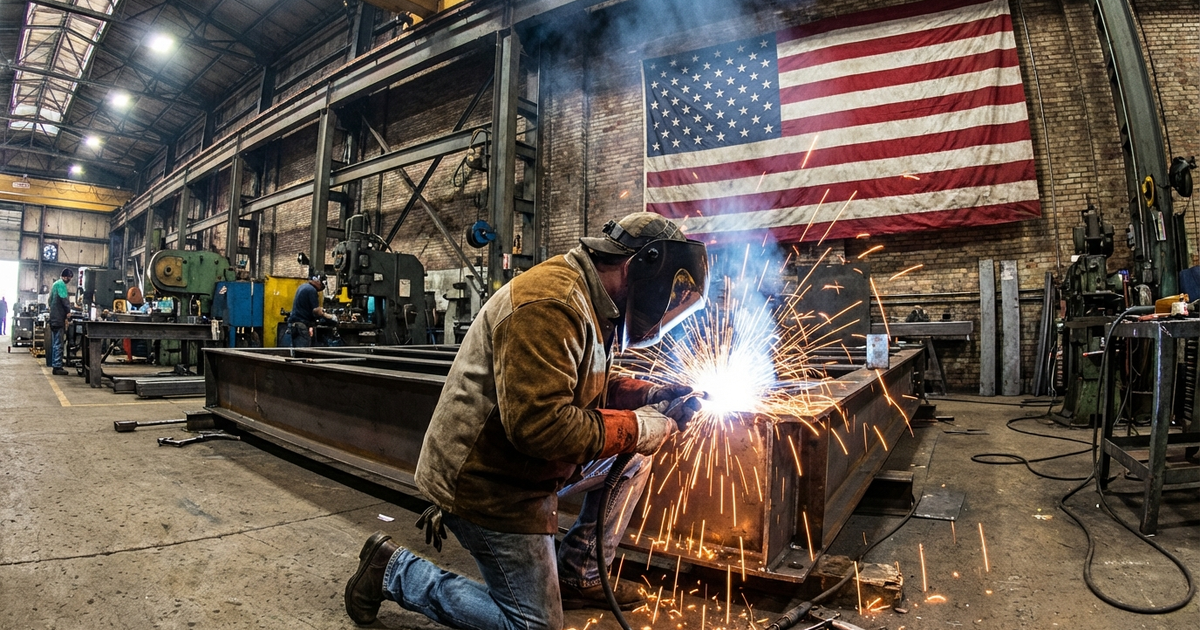
For generations, manufacturing was the backbone of the American middle class. A worker without a college degree could walk into a factory, earn a wage that supported a family, buy a home, and build a life with dignity and purpose. Manufacturing jobs paid well not because of charity but because they required skill, discipline, and expertise that took years to develop. These jobs anchored communities—the steel towns of Pennsylvania, the auto corridors of Michigan, the textile mills of the Carolinas, the aerospace plants of the Pacific Northwest. When the factory thrived, so did the barber shop, the diner, the hardware store, and the school district. Manufacturing didn't just produce goods; it produced a way of life.
Starting in the 1970s, the United States began offshoring this industrial foundation in pursuit of cheaper labor overseas. Trade agreements prioritized corporate flexibility over worker stability. Tax policy rewarded companies that moved production abroad. The result was devastating: the nation lost nearly 8 million manufacturing jobs between 1979 and 2020[1], hollowing out the communities that depended on them. Entire regions were left behind—not temporarily, but permanently. The jobs that replaced factory work paid less, offered fewer benefits, and provided none of the stability or sense of purpose that manufacturing had delivered. Retraining programs promised a bridge to the new economy, but for most displaced workers that bridge led nowhere. The consequences went beyond economics: communities that lost their industrial base experienced surging rates of opioid addiction, family breakdown, and deaths of despair that continue to this day[2].
The loss was not only economic and social—it was strategic. The United States can no longer produce many of the goods its military needs to fight and win. In the event of a sustained conflict, America would be unable to manufacture sufficient ammunition, missiles, ships, and critical components to supply its armed forces and allies[3]. The defense industrial base that won the Second World War has been reduced to a handful of contractors who cannot surge production when it matters most. Meanwhile, China has become the world's dominant manufacturer, producing more steel, ships, and electronics than any other nation, and has used that industrial power to build a military that increasingly challenges American interests.
Rebuilding American manufacturing is not nostalgia—it is necessity. This legislation aims to put Americans back to work in high-paying manufacturing jobs by making it profitable to build things in the United States again. Through tax incentives, federal matching funds for new factories, strengthened Buy American requirements, and workforce development programs focused on the skilled trades, the bill creates the conditions for a manufacturing renaissance. It demands that companies receiving federal support pay prevailing wages, provide health insurance and retirement benefits, and keep production domestic for at least 15 years. These are not just manufacturing jobs—they are careers that can rebuild the working class and restore economic dignity to communities that have been written off for decades.
The bill also establishes a National Manufacturing Strategy Commission to identify which industries matter most for both economic prosperity and national defense, and authorizes Grand National Projects—large-scale undertakings in critical infrastructure, advanced energy, and strategic capacity that put American workers and ingenuity to work on challenges worthy of a great nation. America has always been at its best when it builds—the transcontinental railroad, the Interstate Highway System, the Apollo program. This legislation is an invitation to build again.
Problems the Bill Aims to Solve
Decades of Manufacturing Job Losses Have Gutted the Working Class. The United States lost nearly 8 million manufacturing jobs between 1979 and 2020[1]. These were not marginal positions—they were skilled, well-paying careers that allowed workers without college degrees to own homes, raise families, and retire with security. No sector of the economy has replaced what manufacturing provided: stable employment at middle-class wages with health insurance, pensions, and a sense of professional identity. The workers displaced by offshoring were not absorbed into equivalent jobs; they were pushed into lower-wage service work, forced into early retirement, or dropped out of the labor force entirely.
The Disappearance of the Path to the Middle Class Without a Degree. Manufacturing once offered the clearest route from working poverty to middle-class stability for Americans who did not attend college. A high school graduate could apprentice as a machinist, welder, or electrician and earn a family-sustaining wage within a few years. That pathway has largely vanished. Today, workers without four-year degrees face a labor market that offers fewer opportunities for advancement, lower wages, and less job security than at any point since the Great Depression. Rebuilding manufacturing is the most direct way to restore economic mobility for the majority of Americans who do not hold bachelor's degrees.
Devastated Communities and Human Costs. The closure of factories did not just eliminate jobs—it destroyed communities. Towns that lost their industrial base experienced cascading failures: population decline, collapsing tax revenues, deteriorating schools and infrastructure, shuttered Main Street businesses, and a loss of civic identity. The human toll has been staggering. Regions hit hardest by deindustrialization have experienced surging rates of opioid addiction, alcohol abuse, suicide, and family dissolution—what economists and public health researchers have termed "deaths of despair." These are not independent crises; they are consequences of an economy that abandoned the people who built it.
Erosion of Manufacturing Knowledge and Skilled Trades. As production moved overseas, the United States lost not just jobs but the institutional expertise, skilled trades, and technical knowledge that take generations to develop. Master machinists, tool-and-die makers, welders, and industrial engineers retired without passing their knowledge to the next generation. Vocational programs were defunded in favor of college-for-all policies that left the skilled trades without a pipeline of new talent. This capability cannot be rebuilt overnight—it requires sustained investment in apprenticeships, community college programs, and on-the-job training partnerships with manufacturers.
Weakened National Security and Defense Industrial Capacity. Dependence on foreign manufacturing for critical goods—including defense materials, semiconductors, pharmaceuticals, and rare earth minerals—creates strategic vulnerabilities that adversaries can exploit. In a sustained conflict, the United States would struggle to produce sufficient ammunition, missiles, ships, and replacement parts to supply its armed forces and allies. China now dominates global manufacturing output and has used that industrial power to build military capacity that directly challenges American interests. Restoring domestic manufacturing is not just an economic priority—it is a national security imperative.
Insufficient Surge Production Capacity. Current manufacturing infrastructure is optimized for peacetime efficiency and just-in-time delivery, not for the demands of a national emergency. Whether the crisis is a military conflict, a pandemic, or a natural disaster, the United States lacks the industrial depth to rapidly scale production of critical goods. The COVID-19 pandemic exposed this vulnerability when the nation could not produce sufficient protective equipment, ventilators, or pharmaceuticals domestically.
Failed Promises of Retraining and the "New Economy." For decades, displaced manufacturing workers were told that retraining programs and the transition to a knowledge economy would replace what they lost. For the vast majority, this did not happen. Federal retraining programs have consistently shown limited results[4]—most participants end up in jobs paying significantly less than their prior manufacturing employment. The promise of the service economy and the gig economy has meant lower wages, no benefits, unpredictable schedules, and no path to advancement. Policy must move beyond retraining rhetoric and instead create the actual jobs that working Americans need.
Lack of Strategic Vision for American Industry. The nation has not articulated a cohesive plan for which industries to prioritize or how to align manufacturing investment with long-term national interests. Other nations—China, Germany, Japan, South Korea—pursue deliberate industrial strategies that direct investment toward sectors critical to economic competitiveness and national security. The United States has largely left these decisions to market forces that optimize for short-term shareholder returns rather than long-term national strength. A strategic manufacturing policy is not central planning—it is the recognition that some industries matter more than others for the prosperity and security of the nation.
America Works and National Security Act
120th Congress, 2nd Session
Be it enacted by the Senate and House of Representatives of the United States of America in Congress assembled,
Sec. 1. SHORT TITLE.
This Act may be cited as the "America Works and National Security Act."
Sec. 2. DEFINITIONS.
- (1) COMMISSION.—The term "Commission" means the National Manufacturing Strategy Commission established under Section 3.
- (2) CRITICAL SECTOR.—The term "critical sector" means defense and aerospace, semiconductors and advanced electronics, pharmaceuticals and medical devices, rare earth elements and critical minerals, and advanced energy systems.
- (3) DOMESTIC FACILITY.—The term "domestic facility" means a manufacturing facility located within the United States in which not less than 80 percent of value-added production activity occurs.
- (4) GRAND NATIONAL PROJECT.—The term "Grand National Project" means a large-scale infrastructure or industrial undertaking designated by the Commission as serving a vital national interest.
Sec. 3. NATIONAL MANUFACTURING STRATEGY COMMISSION.
- (1) There is established within the Department of Commerce a National Manufacturing Strategy Commission, chaired by the Secretary of Commerce and including the Secretaries of Defense, Labor, and Energy, plus representatives from domestic manufacturers and organized labor.
- (2) DUTIES.—The Commission shall develop a comprehensive 10-year National Manufacturing Strategy within 18 months, identify critical sector vulnerabilities, recommend investments and procurement reforms, and designate Grand National Projects.
Sec. 4. TAX INCENTIVES FOR CRITICAL SECTOR MANUFACTURING.
- (1) A manufacturing investment tax credit shall equal 25 percent of qualified capital expenditures for construction or expansion of domestic facilities in a critical sector, and 15 percent for modernization of existing facilities.
- (2) Credits shall be available for ten years after enactment.
- (3) RECAPTURE.—A taxpayer that ceases manufacturing or relocates more than 20 percent of capacity outside the United States within ten years shall repay the full credit plus interest.
Sec. 5. FEDERAL MATCHING FUNDS FOR FACILITY CONSTRUCTION.
- (1) The Secretary of Commerce shall establish a Federal Manufacturing Facility Matching Fund providing dollar-for-dollar matching grants, not to exceed $250,000,000 per project.
- (2) CONDITIONS.—Recipients shall maintain domestic production for not fewer than 15 years, pay prevailing wages, and provide health insurance and retirement benefits.
- (3) There are authorized to be appropriated $20,000,000,000 for fiscal years 2026 through 2035.
Sec. 6. WORKFORCE DEVELOPMENT GRANTS.
- (1) The Secretary of Labor shall award competitive grants to community colleges, registered apprenticeship programs, and workforce development boards for manufacturing skills training.
- (2) Priority shall be given to communities with significant manufacturing job losses, programs partnering with manufacturers to guarantee employment, and programs serving veterans.
- (3) There are authorized to be appropriated $5,000,000,000 for fiscal years 2026 through 2035.
Sec. 7. DEFENSE PRODUCTION RESERVE.
- (1) Each DOD contractor with contracts exceeding $50,000,000 shall maintain demonstrated surge production capacity of not less than 150 percent of baseline output.
- (2) Each contractor shall submit an annual surge capacity certification to the Secretary of Defense.
- (3) Non-compliant contractors shall be subject to a contract price reduction of not less than 5 percent and ineligibility for new defense contracts until compliance is achieved.
Sec. 8. BUY AMERICAN STRENGTHENING.
- (1) The domestic content threshold for Federal procurement is increased to not less than 75 percent of component cost, rising to 85 percent within 5 years.
- (2) No waiver may be granted unless the agency head certifies in writing that no domestic alternative exists, a 30-day Federal Register notice is published, and the Commission is consulted.
Sec. 9. GRAND NATIONAL PROJECTS PROGRAM.
- (1) The Commission may designate not more than 5 Grand National Projects at any time in areas such as critical infrastructure, advanced energy, strategic transportation, water security, and space and defense industrial capacity.
- (2) Each project shall be eligible for direct Federal appropriations, tax-exempt bond authority, and streamlined Federal permitting not to exceed 2 years.
- (3) Not less than 90 percent of materials and labor shall be sourced domestically.
Sec. 10. ANNUAL REPORT TO CONGRESS.
Not later than March 1 of each year, the Commission shall submit a report on manufacturing employment, capacity, critical sector supply chain vulnerabilities, defense industrial base readiness, and Grand National Project status.
Sec. 11. EFFECTIVE DATE.
This Act shall take effect 90 days after enactment.
Sources
- Bureau of Labor Statistics, "All Employees, Manufacturing," Current Employment Statistics (CES). https://fred.stlouisfed.org/series/MANEMP
- U.S. Congress Joint Economic Committee, "Long-Term Trends in Deaths of Despair," Social Capital Project Report No. 4-19. https://www.jec.senate.gov/public/index.cfm/republicans/analysis?id=B29A7E54-0E13-4C4D-83AA-6A49105F0F43
- Congressional Research Service, "The U.S. Defense Industrial Base: Background and Issues for Congress," R47751. https://crsreports.congress.gov/product/details?prodcode=R47751
- U.S. Government Accountability Office, "Employment and Training Programs: Department of Labor Should Assess Efforts to Coordinate Services Across Programs," GAO-19-200. https://www.gao.gov/products/gao-19-200